The story, pillar 1 of 4A história, pilar 1 de 4
The inventorO inventor
One idea for one valve: rebuild the malformed tricuspid valve into a cone of the patient's own tissue. This pillar follows the idea from its first published series to its current refinements.Uma ideia para uma valva: reconstruir a valva tricúspide malformada em um cone feito do tecido do próprio paciente. Este pilar acompanha a ideia da primeira série publicada aos refinamentos atuais.
The problem he set out to solve
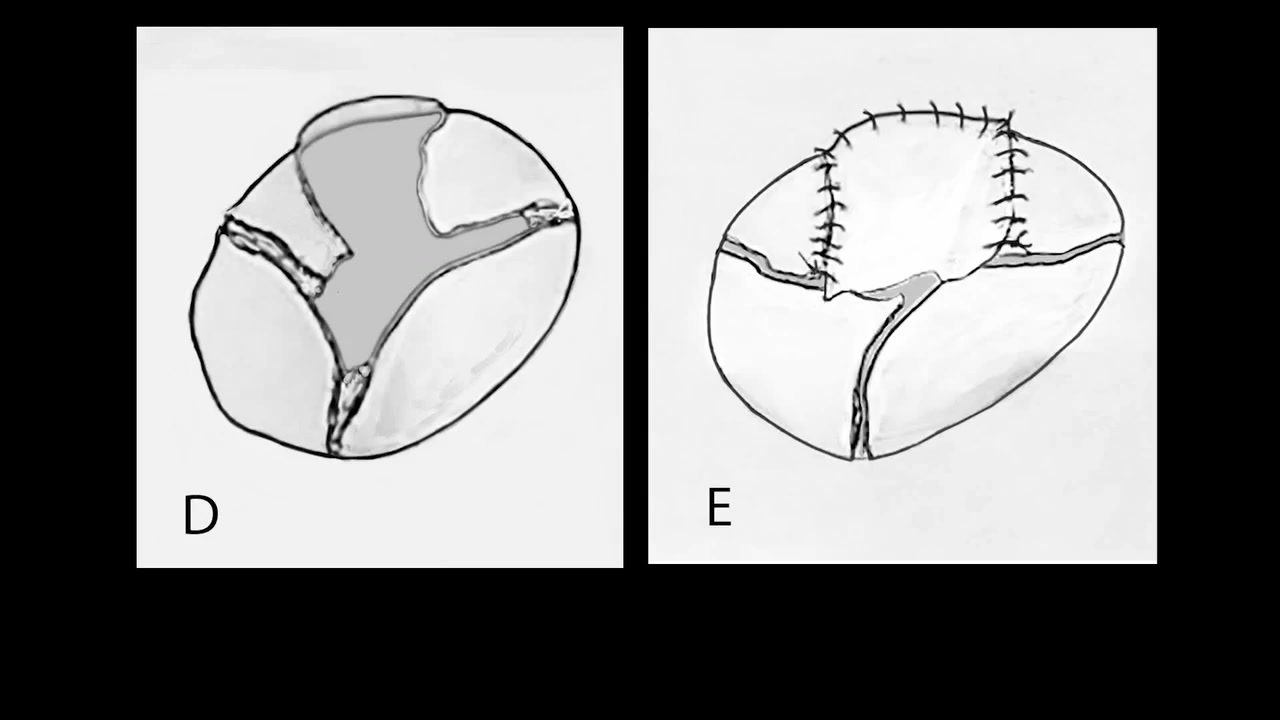
Ebstein anomaly displaces and tethers the leaflets of the tricuspid valve, so the valve leaks and the right side of the heart changes shape. Before circumferential reconstruction, repairs relied mainly on a single large leaflet closing against the septum, and when repair was not possible the valve was replaced with a prosthesis. The sources describe the cone as a different approach: mobilize all usable leaflet tissue, join it into a cone that closes leaflet against leaflet, and reattach it at the true annulus (PMID 17198815, PMID 22424507).
From concept to routine use
The institutional biography dates the initial development of the technique to 1989 and its routine use to 1993, after training in Brazil and at the Cleveland Clinic; some surgical papers use 1993 as the technique's creation date (UPMC biography institutional). The portal keeps the two dates separate, as the sources do: one is the concept, the other its clinical implementation.
Dr. da Silva told the story himself in a lecture at the 2026 Da Silva Center symposium. He had learned the Danielson repair at the Cleveland Clinic. The first patient he repaired that way did well, but the second was left with significant tricuspid regurgitation. In 1989 he started working on a new technique, and in 1993 he operated on the first patient with it (lecture, from 3:07 video).
The first published series
The first report, in 2004 in Arquivos Brasileiros de Cardiologia, described 21 patients, one hospital death and predominantly mild residual leakage at a mean follow-up of about four years (PMID 15073647). The foundational paper followed in 2007 in The Journal of Thoracic and Cardiovascular Surgery: 40 patients operated on between 1993 and 2005, one hospital and one late death, two later re-repairs, and improvement in regurgitation and functional class over a mean four-year follow-up (PMID 17198815). A 52-patient follow-up in 2011 (PMID 21830001) and a technical account describing experience in 100 patients with 3% hospital mortality and no valve replacement in that experience (PMID 22424507) completed the early progression. These are successive reports and may share patients.
The work was collaborative. Recurrent coauthors in the Brazilian series include José Francisco Baumgratz, Luciana da Fonseca, Lílian Maria Lopes and José Henrique Andrade Vila.
Evaluation by other centers
Other teams evaluated the technique. A European series of 20 patients examined the effect of the repair on right ventricular size and function (PMID 25535206). A retrospective comparison of 151 operations at one center estimated recurrent moderate-or-greater regurgitation at five years at 8% after cone repair versus 32% after other repairs, noting that cone follow-up was shorter and that technique selection was not randomized (PMID 32711971). UPMC's biography describes international teaching and continued refinement of the method; the sources do not provide a country-by-country adoption inventory, and the portal does not invent one.
Refining the idea
Recent coauthored work extends the cone to situations that were once excluded: after a neonatal Starnes palliation, where the patch is removed while preserving the underlying tissue (PMID 34317899, PMID 39181444); after a tricuspid valve replacement, when native leaflets were retained (PMID 37555042); and, in one reported case, after a completed Fontan (PMID 41112453). When leaflet tissue is insufficient, augmentation with the patient's own pericardium has been compared with repairs without a patch in 108 patients, with comparable early valve function and a short median follow-up (PMID 41819162). The authors present these as feasibility in selected patients, not as routine pathways.
What the inventor's own papers do not claim
- That every patient with Ebstein anomaly can be repaired, or that replacement is never necessary.
- A single "success rate": valve competence, survival, symptom improvement and reoperation are reported separately, by cohort.
- That less valve leakage means normal ventricular function: good functional class can coexist with reduced right ventricular systolic measures years later (PMID 32335735).
Still to confirm
The year and the motivation of the first operation now come from Dr. da Silva's own lecture (above), and the first published series came from Hospital São Joaquim of Beneficência Portuguesa in São Paulo (PMID 15073647). The original team, beyond the coauthor lists above, is left for the full biography.
Next pillars: the scientist (the evidence), the teacher (training other surgeons) and the person. The three are drafts.
Questions? Ask the educational assistant.Dúvidas? Pergunte ao assistente educacional.
An AI assistant trained on the published research and the institutional pages listed on this site. It explains terms and helps you prepare questions for your medical team. It does not diagnose and does not book appointments. Its answers are generated automatically and can contain errors.Um assistente de IA baseado nas publicações e nas páginas institucionais listadas neste site. Ele explica termos e ajuda a preparar perguntas para a sua equipe médica. Não faz diagnóstico e não marca consultas. As respostas são geradas automaticamente e podem conter erros.